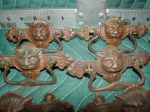
Greetings,
This is my first post on Rare Victorian, so I hope I do not cross any invisible lines of etiquette. A brief introduction might be in order; I've long admired and collected Victorian everything with a special emphasis on Victorian architecture with an equally strong interest in Victorian interiors and their furnishings. Appropriately, I live with my wife in an C. 1889 Eastlake influenced cottage in Fort Worth, TX and have tried to furnish it to period style. It is a perpetual, on-going project. I've also been fascinated with antiques since childhood and was condemned to making that a life-long passion after a well-meaning aunt gave me free reign over her antiques store in a two-story Victorian home for a week when I was a child. Once "infected" with the antiques "bug" only periodic purchases of antiques can keep the affliction at bay, but not for very long. An eight year stint working part time at a local antiques auction in the 1990's did nothing to reduce the cravings, so here I am to co-miserate with my fellow Victoriana enthusiasts. I also restored antiques professionally at my shop for many years but this vicarious pursuit did nothing to reduce my passion for finding antiques. Group therapy can sometimes work wonders but doubtful if that principle also applies here. At this point, it seems I'm incurable. In any event, I'm very impressed with this excellent website and hope my occasional contributions in the future are worthy of the high standards evident here.
Now, as to my query, I recently lucked out at an online auction and bought a substantial 1880's bookcase at what I consider to be a very bargain price. The seller was Witherell's in Sacramento, CA and the owner, Brian Witherell, is well known for quality antiques but not bargain prices. He also appears on the PBS program, Antiques Roadshow, but that is not material in this case. The bookcase in question was advertized as an American Cherrywood Bookcase.
Upon picking it up in Sacramento, (and bringing it back in a trailer to Fort Worth via Portland, OR, but that's another story) I discovered it does not seem to be American or Cherry but in fact is perhaps British or Irish. The "cherry" grain is open, leading me to believe it is actually Mahogany. The hardware is replacement hardware with inappropriate Hepplewhite drawer pulls and tiny escutheons in place of the original five inch long versions seen faintly visible in the finish. There are two missing finials in the top corners of the mirrored spindled gallery. The shelves on the side compartments have odd screw holes regularly spaced which leads me to believe there were some kind of spindlework dividers there originally. Last, in the corners of the mirrored gallery and on the lower doors are shallow relief carvings in a "Celtic Knot" pattern. All-in-all, a pretty eclectic mix of elements and influences. Oh, I suppose some photos might be helpful: http://www.flickr.com/photos/11236515@N05/sets/72157623757520396/ (can't get the hyperlink insertion function to work) Any suggestions as to the country of origin? No maker ID marks have been found. Size is approximately 70 inches to the top and 80 inches across. Thanks for any info. or suggestions!
American or British Victorian Bookcase?
Archive summary
Victorian Furniture thread on victorianforum.com · started April 3, 2010 by vintrest · 7 posts, 4 image attachments · discussion in 2010.
Greetings, This is my first post on Rare Victorian, so I hope I do not cross any invisible lines of etiquette. A brief introduction might be in order; I've long admired and collected Victorian everything with a special emphasis on Victorian architecture with an equally strong…
Hi vintrest, and welcome to the board! :)
A couple of questions as I ponder your lovely bookcase... First, do you have an image of the carved Celtic Knot detail? Second, what is/are the secondary wood/woods? And lastly, does the piece have any locks, and if so, do they (1) appear to be original, and (2), if so, are they marked in any way?
pax~
Cheryl
A couple of questions as I ponder your lovely bookcase... First, do you have an image of the carved Celtic Knot detail? Second, what is/are the secondary wood/woods? And lastly, does the piece have any locks, and if so, do they (1) appear to be original, and (2), if so, are they marked in any way?
pax~
Cheryl
Hi Cheryl,
I added many other detailed photos showing the specific aspects you mentioned such as the intertwined knot carvings, missing finials for the upper spindle gallery ends, and much smaller than orginal escutcheon plate. (with the outline of an older 5" one, long missing, visible in the photo.) The secondary woods used for drawer sides appear to be tulipwood or better known stateside as Poplar. The additional photos have been put in the same album as the previous ones: http://www.flickr.com/photos/11236515@N05/sets/72157623757520396/
I'm increasingly convinced that this is a British piece made of Mahogany either from England, Scotland, or Ireland. A lot of nice Victorian era furniture has been shipped to the U.S. in the past few decades. At the aforementioned auction house where I worked part-time, we received a 40 foot long container from our U.K shippers about every week. Although few pieces were this nice, occasionally a higher-end example would show up. Mostly, the better U.K. pieces were tables, wardrobes, or sideboard/hunt cabinets. Mahogany was used in some better pieces as was Oak. Hope this might help you or someone else to ID this bookcase as American or British. Regardless, we already love the bookcase and are in the process of setting it up. I carefully removed the doors, drawers, upper gallery and shelves to pack and now will reassemble. Thanks as well for the kind words about the bookcase.
I added many other detailed photos showing the specific aspects you mentioned such as the intertwined knot carvings, missing finials for the upper spindle gallery ends, and much smaller than orginal escutcheon plate. (with the outline of an older 5" one, long missing, visible in the photo.) The secondary woods used for drawer sides appear to be tulipwood or better known stateside as Poplar. The additional photos have been put in the same album as the previous ones: http://www.flickr.com/photos/11236515@N05/sets/72157623757520396/
I'm increasingly convinced that this is a British piece made of Mahogany either from England, Scotland, or Ireland. A lot of nice Victorian era furniture has been shipped to the U.S. in the past few decades. At the aforementioned auction house where I worked part-time, we received a 40 foot long container from our U.K shippers about every week. Although few pieces were this nice, occasionally a higher-end example would show up. Mostly, the better U.K. pieces were tables, wardrobes, or sideboard/hunt cabinets. Mahogany was used in some better pieces as was Oak. Hope this might help you or someone else to ID this bookcase as American or British. Regardless, we already love the bookcase and are in the process of setting it up. I carefully removed the doors, drawers, upper gallery and shelves to pack and now will reassemble. Thanks as well for the kind words about the bookcase.
Hmmmm, very nice bookcase. Yeah, i think its mahogany as well but hey, thats not a bad thing, they dont call it the wood of kings for nothing. The Hepplewhite pulls are a puzzle but so are the feet, Chippendale.
If the secondary wood is indeed poplar, that points to an American piece as poplar is unique to the american continent.
If the secondary wood is indeed poplar, that points to an American piece as poplar is unique to the american continent.
Quote from: jacon4
Hmmmm, very nice bookcase. Yeah, i think its mahogany as well but hey, thats not a bad thing, they dont call it the wood of kings for nothing. The Hepplewhite pulls are a puzzle but so are the feet, Chippendale.
If the secondary wood is indeed poplar, that points to an American piece as poplar is unique to the american continent.
Indeed, the secondary wood makes me lean toward a North American origin as well; from our experience, English pieces usually have oak as the secondary wood. An English-made lock should be marked with the manufacturer's name.
Re: the carved motif on the doors. Our modern interpretation of such designs is "Celtic", but in the nineteenth century such interlaced designs were recognized most commonly as being a part of the decorative arts vocabulary of Moorish Spain, and the Near East, along with the British Isles. The carved detail combined with the overtly "Moorish" detail framing the mirror may give an indication of the designer's intent, however. Rather than two disparate exotic "quotes" from the historic design lexicon, perhaps the embellishment was meant as a unified and fashionable nod to the "Moresque" or "Arabian" styles (as interpreted by trade publications, circa 1890).
Hi vintrest and welcome. Very nice bookcase w/ nice details. I am a professional cabinetmaker and without question it is definitely Mahogany (probably Honduras Mahogany). I was fairly certain when you posted the first pics - by the drawer front, but the better pics you posted that show the grain up close make it an absolute certainty. I am really surprised an auction house like Witherell's would misidentify Mahogany as Cherry?? I sometimes wonder about the "expert opinions". The secondary wood (drawer sides and backs) does look like Poplar - it like many woods browns down in color over time (the heartwood of newly cut Poplar has a definite green shade, the sapwood is cream colored, but over time both will turn brown - the heartwood will be a darker shade of brown). I believe it is American made - but I can't say w/ certainty. Others here may have a better idea to it's origin.
While looking at your bookcase pics on Flicker - I also looked at the rest of your photo stream (yes, all 1,006 photos - I'm recovering from surgery so I have time to kill. It was a pleasant way to pass the time.) I can see you definitely do have the bug and are passionate about Victorian architecture - many great pictures. I am too, my wife and I do the same thing. We will make a destination trip of a town that we heard/ learned had some great Victorian buildings in it - just to walk around and see them. I own 20 -30 books on Victorian homes, painted ladies, etc. - so some of your photos I've seen, but was pleasantly surprised to see some very ornate and unique houses that I've never seen before. I particularly like the homes shown from Bradford PA, and Millheim PA (I'm restoring and antique Rosewood pool table right now that I've got to deliver when done very near to Millheim PA and plan to check the town out - thanks to your pics. and also Bellefonte PA - which is close by and I've also heard a lot about but never visited. I look forward to it). As a cabinetmaker - I love and appreciate details. I love Queen Anne's and anything dripping with ornamentation (tastefully done of course - I've seen lots of abominations and poorly balanced designs too). The Carson Mansion in Eureka is my kind of house. Nice also that you show a lot of close-ups of details that are otherwise lost in an overall picture, and angles not commonly seen - my compliments. Look forward to your future posts.
I also saved and posted 3 pics of your bookcase to include them w/ the listing (there are more at the link provided above). To post pics. Click on "Additional Options" - then Browse to the location on your computer. Click "more attachments" for additional pics. (up to 8 per post). If pics are too large you may have to edit them down in size to post. woodwright
While looking at your bookcase pics on Flicker - I also looked at the rest of your photo stream (yes, all 1,006 photos - I'm recovering from surgery so I have time to kill. It was a pleasant way to pass the time.) I can see you definitely do have the bug and are passionate about Victorian architecture - many great pictures. I am too, my wife and I do the same thing. We will make a destination trip of a town that we heard/ learned had some great Victorian buildings in it - just to walk around and see them. I own 20 -30 books on Victorian homes, painted ladies, etc. - so some of your photos I've seen, but was pleasantly surprised to see some very ornate and unique houses that I've never seen before. I particularly like the homes shown from Bradford PA, and Millheim PA (I'm restoring and antique Rosewood pool table right now that I've got to deliver when done very near to Millheim PA and plan to check the town out - thanks to your pics. and also Bellefonte PA - which is close by and I've also heard a lot about but never visited. I look forward to it). As a cabinetmaker - I love and appreciate details. I love Queen Anne's and anything dripping with ornamentation (tastefully done of course - I've seen lots of abominations and poorly balanced designs too). The Carson Mansion in Eureka is my kind of house. Nice also that you show a lot of close-ups of details that are otherwise lost in an overall picture, and angles not commonly seen - my compliments. Look forward to your future posts.
I also saved and posted 3 pics of your bookcase to include them w/ the listing (there are more at the link provided above). To post pics. Click on "Additional Options" - then Browse to the location on your computer. Click "more attachments" for additional pics. (up to 8 per post). If pics are too large you may have to edit them down in size to post. woodwright
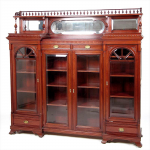
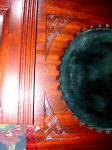
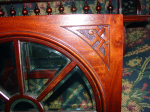
Hi Again,
Many thanks to everyone who has replied: Cheryl, Jacon, and especially Woodwright. Glad we seem to have a consensus among us that the primary wood for this unusual bookcase is Mahogany rather than Cherry as was advertized in the auction ad: http://bid.igavelauctions.com/Bidding.taf?_function=detail&Auction_uid1=1718952&_UserReference=7F00000146B432DEA81CE29D443E4B918B62
(again, hope this link works) Brian Witherell was the seller of this piece on behalf of a Petaluma, CA collector who specializes in collecting L.C. Tiffany pieces. In this collector's auction consignment were several documented Herter Bros, pieces but they failed to sell. A robust R.J. Horner Partner's Desk supported by finely carved winged griffins did sell for a respectable $6,850. Other lesser pieces sold for the proverbial song including an American Renaissance Revival high back walnut bed with finely carved crest brought a miniscule $200. (there should have been another zero addded to the number) An equally fine carrera marble "turtle" top table with fine rococo floral carving also sold for almost nothing. (either $150 or $200 as I recall) Brian Witherell helped me load the bookcase at his shop and I commented to him that the sale must have been a "Wednesday Massacre". He grimaced and quitely agreed. Brian is a super nice guy and I got to meet his Mother and Daughter as well. I told him I would put out the word about the incredible bargains and maybe the next sale would be more rewarding. The only things that sold well in this otherwise lackluster auction were the art objects and paintings. For some reason, no matter how hard the times, paintings and sculptures still bring healthy prices. This sale was conducted by a new online auction house "igavelauctions.com" associated with Lark E. Mason, a friend of Brian Witherell and a co-apparaiser on PBS's Antiques Roadshow.
In conclusion, I think the jury is still out about the country of origin; perhaps someone else can make a more conclusive identification in the future. Based on the many English pieces I've seen over the years, I still lean towards a U.K. origin. While it is a nice piece, it is not by a famous maker. I agree with Cheryl it definitely shows some "Moorish" flavor. I do not particularly like the Hepplewhite brasses so I have bought some replacements which I think are more in tune with the "eclectic" blend of styles in this piece. (see drawer pulls photo) I also need to find an appropriate pair of keyhole escutcheons/backing plates about five inches long In the mid to late 1880's tastes were changing so rapidly that makers had to cater to a wide variety of stylistic tastes. One way to appeal to a wider audience was to incorporate several design influences in one piece. I have an original C. 1890 oak overmantle in our home which shows several different design directions also made to blend in with different "styles" and sell to a wider audience.
Last, while I would certainly like to expand on Woodwright's architectural discussion, perhaps it would be best to PM me, if you would wish. I have two online Victorian architectural discussion groups which I will not promote here. (out of respect for this site) Woodwright, please accept my wishes for a speedy recovery and to all Happy Easter holiday wishes. Thanks again for the good replies.
Many thanks to everyone who has replied: Cheryl, Jacon, and especially Woodwright. Glad we seem to have a consensus among us that the primary wood for this unusual bookcase is Mahogany rather than Cherry as was advertized in the auction ad: http://bid.igavelauctions.com/Bidding.taf?_function=detail&Auction_uid1=1718952&_UserReference=7F00000146B432DEA81CE29D443E4B918B62
(again, hope this link works) Brian Witherell was the seller of this piece on behalf of a Petaluma, CA collector who specializes in collecting L.C. Tiffany pieces. In this collector's auction consignment were several documented Herter Bros, pieces but they failed to sell. A robust R.J. Horner Partner's Desk supported by finely carved winged griffins did sell for a respectable $6,850. Other lesser pieces sold for the proverbial song including an American Renaissance Revival high back walnut bed with finely carved crest brought a miniscule $200. (there should have been another zero addded to the number) An equally fine carrera marble "turtle" top table with fine rococo floral carving also sold for almost nothing. (either $150 or $200 as I recall) Brian Witherell helped me load the bookcase at his shop and I commented to him that the sale must have been a "Wednesday Massacre". He grimaced and quitely agreed. Brian is a super nice guy and I got to meet his Mother and Daughter as well. I told him I would put out the word about the incredible bargains and maybe the next sale would be more rewarding. The only things that sold well in this otherwise lackluster auction were the art objects and paintings. For some reason, no matter how hard the times, paintings and sculptures still bring healthy prices. This sale was conducted by a new online auction house "igavelauctions.com" associated with Lark E. Mason, a friend of Brian Witherell and a co-apparaiser on PBS's Antiques Roadshow.
In conclusion, I think the jury is still out about the country of origin; perhaps someone else can make a more conclusive identification in the future. Based on the many English pieces I've seen over the years, I still lean towards a U.K. origin. While it is a nice piece, it is not by a famous maker. I agree with Cheryl it definitely shows some "Moorish" flavor. I do not particularly like the Hepplewhite brasses so I have bought some replacements which I think are more in tune with the "eclectic" blend of styles in this piece. (see drawer pulls photo) I also need to find an appropriate pair of keyhole escutcheons/backing plates about five inches long In the mid to late 1880's tastes were changing so rapidly that makers had to cater to a wide variety of stylistic tastes. One way to appeal to a wider audience was to incorporate several design influences in one piece. I have an original C. 1890 oak overmantle in our home which shows several different design directions also made to blend in with different "styles" and sell to a wider audience.
Last, while I would certainly like to expand on Woodwright's architectural discussion, perhaps it would be best to PM me, if you would wish. I have two online Victorian architectural discussion groups which I will not promote here. (out of respect for this site) Woodwright, please accept my wishes for a speedy recovery and to all Happy Easter holiday wishes. Thanks again for the good replies.