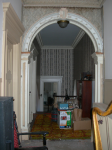
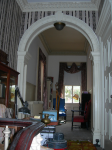
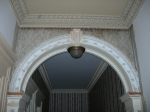
This is Wayne from Mason & Wolf. Cheryl answered some of your questions and pointed you to the Gov. Lippitt and Morse-Libby houses, which are the same time period as your house and compare well. First, the painted decoration in your house is extraordinary. It merits proper documentation in its current state. The good news is: it is spectacular. The bad news is: spectacular is neither easy nor inexpensive to conserve/restore. This kind of intact decoration, no matter how damaged, requires that you tread softly and take your time. It also requires some evaluation by experienced experts. This is not a job to be attempted by amateurs or tradespeople with modest skills. I would contact the NJ Historic Preservation Office
www.state.nj.us/dep/hpo. Every state has a HPO. They will understand the significance of your historic interior decoration and can offer guidance. There are firms that specialize in painted decoration like yours. John Canning is just one who comes to mind:
www.canning-studios.com. There are also historic preservation consultants that can assist. Gail Winkler also comes to mind. She is just across the river in Philadelphia 215-925-8367. Understand that there are other folks who do this kind of work; Canning and Winkler are just two of the many experts who have excellent resumes.
BTW - Your house was recorded by the Historic American Buildings Survey. Just Google HABS and search for the William Sharp house in Salem, NJ. There's one exterior photo and a short description of the exterior. Nothing on the interior though. Rats!
On to wallpaper. You have good instincts. Bare plaster (never painted) is almost certainly evidence that wallpaper was hung at one time. No Victorian would have lived with bare plaster walls anymore than we would roll out the carpet and move in the sofa after the sheetrock was taped and spackled. You are right. William Morris is not right for your house. Finding period appropriate wallpaper will take some time and dedication of funds. To start, look at what was manufactured in the 1860s. There's a number of books on historic wallpaper that can be found in better libraries. You are lucky; The Athenaeum of Philadelphia is close by and they have a huge library dedicated to all things 19th century. Plan to spend a whole day there - you will still be roaming the stacks when they tell you it's closing time.
OK, reading about historic wallpaper (and looking at the pictures) will tell you what you could buy in 1862, but what can you buy now? I would get a copy of Fabrics and Wallpapers for Historic Buildings by Jane and Richard Nylander. This is the only book that is completely focused on what is being reproduced today. More manufacturers have entered the market since this book was published and more paterns are being reproduced every day - best to contact the manufacturers to find out what they have to offer for your time period.
Now, let's look at the givens. Your house is Italianate and the plasterwork is classical/rococo. That is consistent with what was being bult in that time period. The house appears to have been spared heavy remodeling - doors, windows, plasterwork, woodwork, wall treatments, and glass appear to be mostly intact and of the same period.
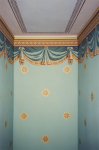
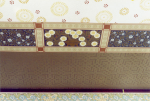
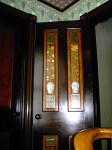
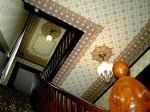
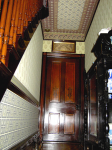
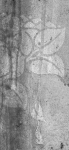
Your photos of the vestibule show wonderful classical motifs on the walls, not unlike some of the French wallpapers from the first half of the century. The ceiling decoration complements and repeats the classical decoration on the walls. Makes sense, right? An Italianate house would look to Rome and the ancient classical world for inspiration.
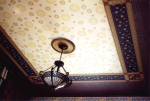
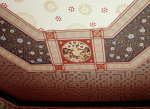
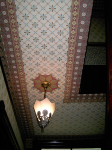
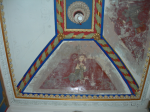
Another photo shows a stunning paint-decorated ceiling. It is quite elaborate and would have cost a pretty penny in the 1860s. I suspect that the work was done by highly-trained decorative painters operating out of Philadelphia. They advertised as "fresco painters" although the technique is not true fresco.
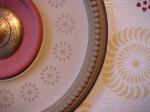
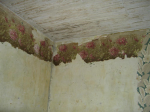
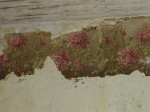
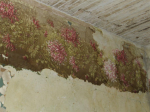
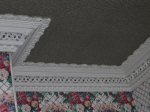
The close up photo of the plaster cornice (same room?) shows how the color and goldleaf highlights used to decorate the ceiling would be carried down to decorate the plaster encircling the room.
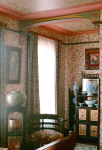
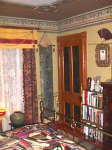
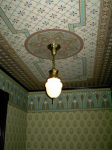
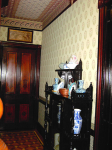
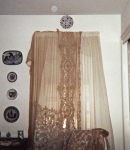
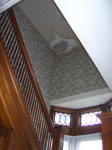
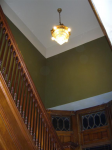
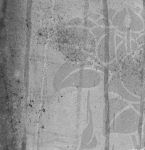
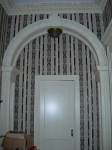
In all likelihood, all of the fist floor rooms (the public spaces in the house) would have been decorated with the same degree of sophistication. Which makes me wonder about the photo of the light fixture and plaster ceiling medallion. I bet that medallion got the polychrome treatment and there is painted decoration under the white paint. Likewise, the photo of the room with the rose trellis wallpaper makes me wonder what is hiding under... what is that? Is that a wallaper with a burlap design or grass paper? Ceilings were often papered-over to hide the cracks. Depending on what material it is and what adhesive was used, it may require some special care and a little experimentation to remove it without damaging the ceiling underneath.
From what I can see in the photos, all of the old decoration appears to be of the same style and time period - mid-century. It was probably executed shortly after the house was constructed. Workman signatures can be difficult to puzzle out. Sometimes a later date and signature is from a touch up job, rather than a complete redecoration. That's what I suspect. I don't see the 1881 date as being new work, although classical motifs were constantly being revived.
You will find that painted ceilings are more prevalent than ceiling papers in the mid-century - your house seems to fall in with that trend. In the past thirty years some mid-century wallpaper borders and corner elements have been reproduced, but I don't know if they are currently available. As far as wallpapers, take a cue from the wall decoration in the vestibule. There are several designs from the mid-century that employ classical motifs that have been reproduced (see Nylander). You don't have to "go classical" in every room, since Victorians liked to "mix it up", but you do need to stick to the time period and key the decoration to the ceiling. Some Renaissance patterns and Elizabethan damasks play well with classical design.
Maybe more information than you asked for, but I think your house deserved more than a short answer. I hope I answered some of your questions. I think you have a great house and the surviving decoration is precious. I hope you can manage to bring it back. I am always interested in historic interiors and will try to answer any questions you may have.
Best - Wayne Mason