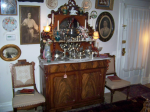
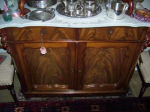
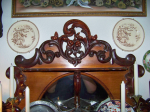
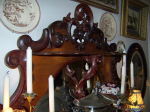
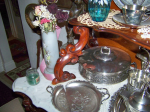
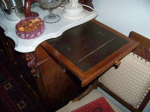
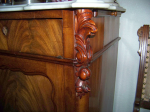
Here is a sideboard that I found in an antique mall in Jefferson City, Mo. The lady I purchased it from told me that she bought it at an estate sale in Mississippi - but whether or not it's a true Southern piece or not, I don't know. I am curious to know if anyone can confirm the type of wood. I was told it is Walnut, but the carvings on the top section are darker than the rest. I don't believe it's been refinished, but then again, I don't know. I have also wondered if it is truly an american piece or if it could be european. It has a very interesting support for the top shelf...the bottom of the support bracket actually rests against the mirror. The first shelf also has carved support brackets that bolt through on the underside of the marble top. I discovered that while I was taking it apart to move it from the antique mall and could'nt figure out why the top wouldn't come free after I had removed all screws holding it to the base. It also has these great little pull out side pieces that add additional flat space to the top. Both sides are very wide width planks and do have separations from age. But overall I felt it was in good condition and unusual in form. I have found no markings, tags, etc. anywhere on this piece.
Shawn
Victorian Sideboard
Archive summary
Victorian Furniture thread on victorianforum.com · started March 26, 2009 by missourivictorian · 4 posts, 8 image attachments · discussion in 2009.
Here is a sideboard that I found in an antique mall in Jefferson City, Mo. The lady I purchased it from told me that she bought it at an estate sale in Mississippi - but whether or not it's a true Southern piece or not, I don't know. I am curious to know if anyone can confirm…
Hey Shawn,
It's really difficult to tell from the pics if its European or American or what kind of wood it is. To my eyes it looks like some kind of fruitwood, possibly mahogany and probably not walnut, but it's hard to tell. I would say if the secondary wood (inside the drawers, on the back etc.) is pine, it's probably American, if it's oak, it's probably European. The pull out side trays are a nice touch!
It's really difficult to tell from the pics if its European or American or what kind of wood it is. To my eyes it looks like some kind of fruitwood, possibly mahogany and probably not walnut, but it's hard to tell. I would say if the secondary wood (inside the drawers, on the back etc.) is pine, it's probably American, if it's oak, it's probably European. The pull out side trays are a nice touch!
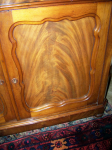
I think this sideboard is mahogany with the door panels and drawer fronts veneered with crotch grain mahogany veneer. One way to identify English case pieces is to look to see if the drawers are lined with with small lengths of quarter round and if the interior has been given a red painted wash. Both of these details are charactistic of English cabinetmaking and were not, to my knowledge, used by American cabinetmakers, at least not at the period when this sideboard was made (1855-1865).
The piece looks English to me. It's smaller size, mirror and shelf indicates it was intended for the parlor (or drawing room as the English would say) or for a breakfast parlor, a room adjoining the drawing where light meals including breakfast were eaten. They would have called it either a drawing room sideboard, a breakfast room sideboard or a chiffonier. The routing of the stiles and rails of the doors into a series of curves and the asymmetical carving at the top of the backboard are particularly characteristic of the 1850s. It would have been made in a furniture factory which is one reason that these pieces were not appreciated by the English until more recently. Because they were comparatively cheap by American standards for the quality of workmanship involved in their manufacture, many examples were imported to America in container shipments in the 1970s.
The piece looks English to me. It's smaller size, mirror and shelf indicates it was intended for the parlor (or drawing room as the English would say) or for a breakfast parlor, a room adjoining the drawing where light meals including breakfast were eaten. They would have called it either a drawing room sideboard, a breakfast room sideboard or a chiffonier. The routing of the stiles and rails of the doors into a series of curves and the asymmetical carving at the top of the backboard are particularly characteristic of the 1850s. It would have been made in a furniture factory which is one reason that these pieces were not appreciated by the English until more recently. Because they were comparatively cheap by American standards for the quality of workmanship involved in their manufacture, many examples were imported to America in container shipments in the 1970s.
Another thing about english construction details, they often used oak as secondary wood for for drawer construction & american makers hardly ever did.