I just acquired this rosewood Renaissance Revival Cabinet yesterday. The cabinet is in need of a complete restoration which will be a substantial effort, but I feel worth the effort. I am not sure who the maker is but I am leaning toward Pottier & Stymus? Any ideas?
Thanks,
Michael
Renaissance Revival Cabinet - Pottier & Stymus?
Archive summary
Victorian Furniture thread on victorianforum.com · started November 23, 2007 by michaelo · 13 posts, 3 image attachments · discussion in 2007–2008.
I just acquired this rosewood Renaissance Revival Cabinet yesterday. The cabinet is in need of a complete restoration which will be a substantial effort, but I feel worth the effort. I am not sure who the maker is but I am leaning toward Pottier & Stymus? Any ideas? Thanks,…
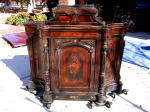
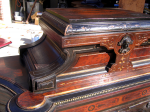
I've scoured the books for some clues but haven't found any except for one Roux piece that had a small medallion top-center like this one, but the rest of the elements didn't work.
I think this is a New York piece but I can't pinpoint who in particular....yet.
I think this is a New York piece but I can't pinpoint who in particular....yet.
I just wanted to say that you got yourself an awesome cabinet. Great find! Looks really nice, regardless of whether or not you have it restored.
I'm wondering...will you be restoring it yourself? If not, who is your secret weapon?
Thank you,
Jason
I'm wondering...will you be restoring it yourself? If not, who is your secret weapon?
Thank you,
Jason
Hello Jason,
Yes, I will be restoring it myself as I am an expert woodworker / upholsterer, while entirely self-taught. I can pretty much handle any furniture restoration task, although I make my living as a Software Engineer. Antiques are primarily a sideline and hobby for me. In reality both of these activities have a lot in common, in that they are very detail oriented if one wants to do a good job.
The cabinet actually looks much better in pictures than in person at this point. There is significant damage from dry-rot in the door which will entail replacing the top rail and re-veneering the bulk of the door in rosewood on both the front and back sides.
In addition the finish is pretty much shot and not salvageable (it is an older, poorly done refinish), so that will be a major task to do correctly on a piece of this type. In keeping with the original finishing techniques, I always work in shellac and do a "french polish" when applicable. For those who have never worked in shellac, let me say that it is rather difficult to apply correctly. I have a lot of respect for those 19th century finishers who did this on a daily basis. Examples of a couple of other cabinets I have worked on can be found on my website at:
http://www.trocadero.com/MichadiAntiques
Thanks,
Michael
Yes, I will be restoring it myself as I am an expert woodworker / upholsterer, while entirely self-taught. I can pretty much handle any furniture restoration task, although I make my living as a Software Engineer. Antiques are primarily a sideline and hobby for me. In reality both of these activities have a lot in common, in that they are very detail oriented if one wants to do a good job.
The cabinet actually looks much better in pictures than in person at this point. There is significant damage from dry-rot in the door which will entail replacing the top rail and re-veneering the bulk of the door in rosewood on both the front and back sides.
In addition the finish is pretty much shot and not salvageable (it is an older, poorly done refinish), so that will be a major task to do correctly on a piece of this type. In keeping with the original finishing techniques, I always work in shellac and do a "french polish" when applicable. For those who have never worked in shellac, let me say that it is rather difficult to apply correctly. I have a lot of respect for those 19th century finishers who did this on a daily basis. Examples of a couple of other cabinets I have worked on can be found on my website at:
http://www.trocadero.com/MichadiAntiques
Thanks,
Michael
Michael:
If I might ask for a bit of advice, what sort of project is a good starting point for beginning a self-taught furniture restoration hobby? Did you start out with a junked-out parlor table or something of the sort? Can you recommend any books on the subject?
I can say that I am a patient & detail-oriented person...no hesitations here about hand-carving stuff to fit properly when it comes to house restoration or stripping paint off of door hinges...and I am also an engineer (naval architect). I probably won't get around to trying my hand at furniture restoration for a number of years as the house restoration is a higher priority. I have a "nice" 1870s renaissance revival partners desk on the back porch...needs a number of mouldings replicated, some veneer patches, and a general re-build. I suspect that I should start with something smaller though. Still, the desk was free, so it is hard to mess it up too bad.
You have a great website!
Thank you,
Jason
If I might ask for a bit of advice, what sort of project is a good starting point for beginning a self-taught furniture restoration hobby? Did you start out with a junked-out parlor table or something of the sort? Can you recommend any books on the subject?
I can say that I am a patient & detail-oriented person...no hesitations here about hand-carving stuff to fit properly when it comes to house restoration or stripping paint off of door hinges...and I am also an engineer (naval architect). I probably won't get around to trying my hand at furniture restoration for a number of years as the house restoration is a higher priority. I have a "nice" 1870s renaissance revival partners desk on the back porch...needs a number of mouldings replicated, some veneer patches, and a general re-build. I suspect that I should start with something smaller though. Still, the desk was free, so it is hard to mess it up too bad.
You have a great website!
Thank you,
Jason
Jason,
With respect to woodworking, I like many kids of my generation took a class in woodshop in junior high school, and then did not revisit the subject until the age of 30 or so. I had acquired several fine Victorian antiques, all of which were in dire need of some attention and could not afford to have someone else do the work at that time; the only option therefore was to learn to do it myself.
My case was probably a prime example of what a budding restorer should NOT do. I started with a J.H. Belter sofa in the Rosalie with Grapes pattern in need of some minor woodwork and a complete upholstery job. Essentially I bit off more than I could chew for a first project, and although the sofa came out stunning, it took me almost 2 years to complete the job. In order to do justice to the piece, I had to not only discover the fundamentals of upholstery, but l had to learn the advanced technique of diamond tufting, using horsehair as a stuffing material as would have been done originally. This task was also complicated by the fact that obtaining documentation on how to accomplish the technique was impossible to find. Diamond tufting using the 19th century materials is somewhat of a lost art, however by visiting the library I was able to glean clues as to how it was done. After compiling evidence from half a dozen upholstery books, none of which described the process from beginning to end, I was able to figure out how to see the job through to completion.
I really don?t possess to many woodworking books other than those giving general how-to information, although in the pre-internet days I did spend a considerable amount of time researching various techniques at the library. For the modern restorer, the same information can be obtained through research (lots of it) on the internet. Nevertheless a lot of what I have learned came simply from trial and error. Perhaps one of the most maddening tasks for me was to learn how to properly apply the gilding to the very fine incised carving you see in higher end Victorian pieces. In every case I have seen gold paint was applied (not metal foil) originally, and I struggled with the tiniest of artist brushes, holding my breath while moving my hand, and yet still could not get a job as nice as the original. The key as it turned out was painting the incised line, expecting it to spill over the edges, and rapidly with a light hand, wiping off the excess. This is complicated by the fact that the solvent which you will invariably need to get all the excess off no matter how fast you are working due to the fact the paint will flow into every imperfection, will react with the underlying finish in a negative way. The solution to this problem then was to use a gold paint with the opposite chemical composition of the underlying finish. Thus if you are finishing the piece in shellac, use an enamel gold paint and clean up the excess with mineral spirits. I realize this appears to be a bit of a digression, but the point I am trying to make is there are many techniques that I have learned that were not found in any book, and I only discovered by creatively ?trying different stuff? until I found something that worked.
Good quality, and appropriate tools are essential if one wants to do a good job (at least if you are planning on completing the job in this lifetime). These can carry a high price tag, but can be acquired one by one as needed over time.
Perhaps the best advice I could give the novice restorer would be:
1) Break the piece down (not literally) into its component tasks.
2) Assign a priority to the task. Which task must come first. Which task is dependent upon the completion of a previous task.
3) Determine what is needed in terms of materials for that given task.
4) Determine what tools are needed for the task and how they can be manipulated to give the desired result.
5) It will often take a considerable amount of time to complete a piece, so focus less on your vision of that completion and more on successfully accomplishing each task / sub-task. In other words avoid burnout, but see the entire job through to completion a little at a time.
By the way I noticed that you are using an icon of a gentleman from the Victorian period displayed alongside your posted messages. I thought I would follow suit, and am using a picture of my great-great-grandfather with whom I share my middle name, circa 1860?s. He was a lawyer in Texas and looked a lot like Buffalo Bill in appearance.
Thanks,
Michael
With respect to woodworking, I like many kids of my generation took a class in woodshop in junior high school, and then did not revisit the subject until the age of 30 or so. I had acquired several fine Victorian antiques, all of which were in dire need of some attention and could not afford to have someone else do the work at that time; the only option therefore was to learn to do it myself.
My case was probably a prime example of what a budding restorer should NOT do. I started with a J.H. Belter sofa in the Rosalie with Grapes pattern in need of some minor woodwork and a complete upholstery job. Essentially I bit off more than I could chew for a first project, and although the sofa came out stunning, it took me almost 2 years to complete the job. In order to do justice to the piece, I had to not only discover the fundamentals of upholstery, but l had to learn the advanced technique of diamond tufting, using horsehair as a stuffing material as would have been done originally. This task was also complicated by the fact that obtaining documentation on how to accomplish the technique was impossible to find. Diamond tufting using the 19th century materials is somewhat of a lost art, however by visiting the library I was able to glean clues as to how it was done. After compiling evidence from half a dozen upholstery books, none of which described the process from beginning to end, I was able to figure out how to see the job through to completion.
I really don?t possess to many woodworking books other than those giving general how-to information, although in the pre-internet days I did spend a considerable amount of time researching various techniques at the library. For the modern restorer, the same information can be obtained through research (lots of it) on the internet. Nevertheless a lot of what I have learned came simply from trial and error. Perhaps one of the most maddening tasks for me was to learn how to properly apply the gilding to the very fine incised carving you see in higher end Victorian pieces. In every case I have seen gold paint was applied (not metal foil) originally, and I struggled with the tiniest of artist brushes, holding my breath while moving my hand, and yet still could not get a job as nice as the original. The key as it turned out was painting the incised line, expecting it to spill over the edges, and rapidly with a light hand, wiping off the excess. This is complicated by the fact that the solvent which you will invariably need to get all the excess off no matter how fast you are working due to the fact the paint will flow into every imperfection, will react with the underlying finish in a negative way. The solution to this problem then was to use a gold paint with the opposite chemical composition of the underlying finish. Thus if you are finishing the piece in shellac, use an enamel gold paint and clean up the excess with mineral spirits. I realize this appears to be a bit of a digression, but the point I am trying to make is there are many techniques that I have learned that were not found in any book, and I only discovered by creatively ?trying different stuff? until I found something that worked.
Good quality, and appropriate tools are essential if one wants to do a good job (at least if you are planning on completing the job in this lifetime). These can carry a high price tag, but can be acquired one by one as needed over time.
Perhaps the best advice I could give the novice restorer would be:
1) Break the piece down (not literally) into its component tasks.
2) Assign a priority to the task. Which task must come first. Which task is dependent upon the completion of a previous task.
3) Determine what is needed in terms of materials for that given task.
4) Determine what tools are needed for the task and how they can be manipulated to give the desired result.
5) It will often take a considerable amount of time to complete a piece, so focus less on your vision of that completion and more on successfully accomplishing each task / sub-task. In other words avoid burnout, but see the entire job through to completion a little at a time.
By the way I noticed that you are using an icon of a gentleman from the Victorian period displayed alongside your posted messages. I thought I would follow suit, and am using a picture of my great-great-grandfather with whom I share my middle name, circa 1860?s. He was a lawyer in Texas and looked a lot like Buffalo Bill in appearance.
Thanks,
Michael
Michael:
I suppose that my interest in restoring antiques is similarly born out of necessity (or a small budget). My sideboard needs work at some point, as does the partners desk that I mentioned. I suspect that I will start with something like an auction-find parlor table and see what I can learn from there. Of course, it is tempting to just find an expert furniture restorer and have everything done with no effort on my end. In any event, I'm not likely to come into possession of a Belter . . . ever. Now...I could see splurging on a Pottier & Stymus some day if it was a bargain, but it would have to be a super-bargain.
I'm not sure if you saw the picture of my aesthetic settee (the Turkish job)...we briefly had a master upholsterer from North Carolina who set up shop in town. His wife had a high-brainpower job at the shipyard where I work, but she didn't stay on for very long and, as a result, my upholstery god-send didn't stick around very long either. Anyway, that fellow did the settee and my rocking chair. I wish that he was still in town.
Speaking of upholstery, have you come across any sources for authentic haircloth (horsehair) that is wider than 30 inches? The cover on my black settee got torn up by my ex-wife. I'm fairly certain that the haircloth on the seat of that settee is wider than 30 inches. That probably sounds like there is a "funny" story to be found here, but there really isn't one. Anyway, I have come across some makers of the cloth, but they all limit the width to 30" on account of the length of the hair on the horse's tail. I'm guessing that, once upon a time, some shops made a more expensive cut that was a little bit wider.
Nice picture of your great-great-grandfather. The picture that I am using is the original owner of my house, Mr. Charles M. Fairchild, and probably dates to the 1870s. I briefly tried a picture of me, but I liked the black-&-white simplicity of Charley. Seems kinda classy to boot.
Thank you,
Jason
I suppose that my interest in restoring antiques is similarly born out of necessity (or a small budget). My sideboard needs work at some point, as does the partners desk that I mentioned. I suspect that I will start with something like an auction-find parlor table and see what I can learn from there. Of course, it is tempting to just find an expert furniture restorer and have everything done with no effort on my end. In any event, I'm not likely to come into possession of a Belter . . . ever. Now...I could see splurging on a Pottier & Stymus some day if it was a bargain, but it would have to be a super-bargain.
I'm not sure if you saw the picture of my aesthetic settee (the Turkish job)...we briefly had a master upholsterer from North Carolina who set up shop in town. His wife had a high-brainpower job at the shipyard where I work, but she didn't stay on for very long and, as a result, my upholstery god-send didn't stick around very long either. Anyway, that fellow did the settee and my rocking chair. I wish that he was still in town.
Speaking of upholstery, have you come across any sources for authentic haircloth (horsehair) that is wider than 30 inches? The cover on my black settee got torn up by my ex-wife. I'm fairly certain that the haircloth on the seat of that settee is wider than 30 inches. That probably sounds like there is a "funny" story to be found here, but there really isn't one. Anyway, I have come across some makers of the cloth, but they all limit the width to 30" on account of the length of the hair on the horse's tail. I'm guessing that, once upon a time, some shops made a more expensive cut that was a little bit wider.
Nice picture of your great-great-grandfather. The picture that I am using is the original owner of my house, Mr. Charles M. Fairchild, and probably dates to the 1870s. I briefly tried a picture of me, but I liked the black-&-white simplicity of Charley. Seems kinda classy to boot.
Thank you,
Jason
This is a nice exchange. Michael, thanks for all that info. Good job. Best of luck with the FINE cabinet.
BornaHeel
BornaHeel
Michael, just noticed that the top center inlay work on your cabinet is identical to the labeled Godey cabinet. A lot of inlay work was imported/bought and incorporated, but it is a clue.
John,
Thanks for keeping an eye out for me on this, however on close inspection I believe you will see they are significantly different.
Michael
Thanks for keeping an eye out for me on this, however on close inspection I believe you will see they are significantly different.
Michael
Michael,
We must be looking at different things - see attached.
Ignoring the lighting differences of an indoor museum photography session and your credenza photo taken outdoors as well as stain color differences, sunlight exposure differences over 130 years, etc., the structure of the design of the two inlays appears identical. The resolution on the Godey photo doesn't provide the pixels to get really good detail comparison, but you can see a resemblance.
John
We must be looking at different things - see attached.
Ignoring the lighting differences of an indoor museum photography session and your credenza photo taken outdoors as well as stain color differences, sunlight exposure differences over 130 years, etc., the structure of the design of the two inlays appears identical. The resolution on the Godey photo doesn't provide the pixels to get really good detail comparison, but you can see a resemblance.
John

John,
You are absolutely correct! Thank you for pointing that out to me.
I believe a trip to the optometrist is called for.
Michael
You are absolutely correct! Thank you for pointing that out to me.
I believe a trip to the optometrist is called for.
Michael
rare, good job, i think you have identified the maker. thats one of the neat things about victorian furniture, theres so MUCH MORE info available if one is willing to search than there is for early amer. for instance. michael, very attractive piece, how much do you think the conservation of a piece like this would cost and what's your plans for same? i see some dings, chips but overall piece looks in good condition finish wise.